
 Trading Education
Slippage vs Spread in Forex Trading
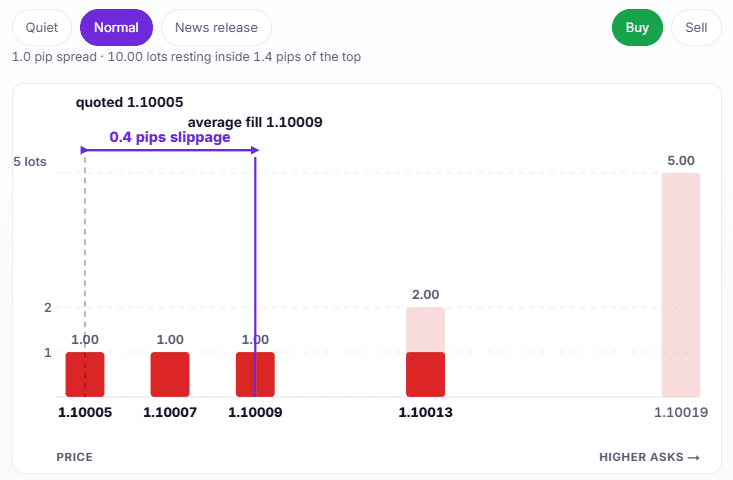
Slippage is the gap between the price you expect and the price your forex order fills at. It differs from spread and depends on available liquidity.
A pip is forex's standard price move. Find it in a quote, work out what it's worth in your account currency, then check it with the pip-value tool.
A pip is the standard unit for a forex price move. Quoting a move as 12 pips instead of 0.00012 keeps every pair on the same scale.
For most pairs, one pip is 0.0001. For Japanese yen pairs, it is 0.01. A pip tells you how far price moved. It does not tell you how much money you made or lost. Those are two different questions, and mixing them up is where most beginners get hurt.
If EUR/USD moves from 1.08425 to 1.08435, it rose by one pip. The difference is 0.00010.
If you trade 0.10 lots, that one-pip move is worth about $1 on EUR/USD, and at 1.00 lot the same move is worth about $10. Same price change. Ten times the money.
Pips also describe a spread, a stop loss, and a take profit. Convert the pip count to money before you decide whether a trade fits your risk limit.
Most forex brokers quote one digit beyond the pip, and that extra digit, the pipette, is what makes beginners miscount a move by a factor of ten. The highlighted digit below is the pip.
| Pair | Example quote | Pip size | Pip position |
|---|---|---|---|
| EUR/USD | 1.08425 | 0.0001 | Fourth decimal place |
| USD/JPY | 150.250 | 0.01 | Second decimal place |
In both rows, the last digit is one-tenth of a pip. Ten of them make one pip.
Traders use these three words loosely. Your platform does not.
| Unit | What it means | EUR/USD example |
|---|---|---|
| Pip | The standard forex price move | 0.0001 |
| Pipette | One-tenth of a pip | 0.00001 |
| Point | The smallest price increment set for that symbol | Usually 0.00001 on a five-decimal quote |
On a five-decimal forex quote, one point is usually one pipette. Ten points make one pip. This is a forex convention, not a rule for every instrument. Gold, indices, and CFDs can use a different point or tick size.
JPY pairs use 0.01 for one pip. USD/JPY moving from 150.250 to 150.260 is a one-pip move.
Yen trades in whole units rather than fractions of a dollar, so the pip sits two decimals in instead of four. Measure a JPY pair with 0.0001 and a ten-pip move reads as 1,000 pips.
For most spot forex symbols, 1.00 lot is 100,000 units of the base currency. Check your broker's contract specification because symbols can differ.
On EUR/USD, the quote currency is USD. One standard lot has a pip value of $10.
| Position size | Units | EUR/USD value per pip |
|---|---|---|
| 1.00 lot | 100,000 | $10.00 |
| 0.10 lot | 10,000 | $1.00 |
| 0.01 lot | 1,000 | $0.10 |
Double the lot size and you double the money per pip. The pip count does not change.
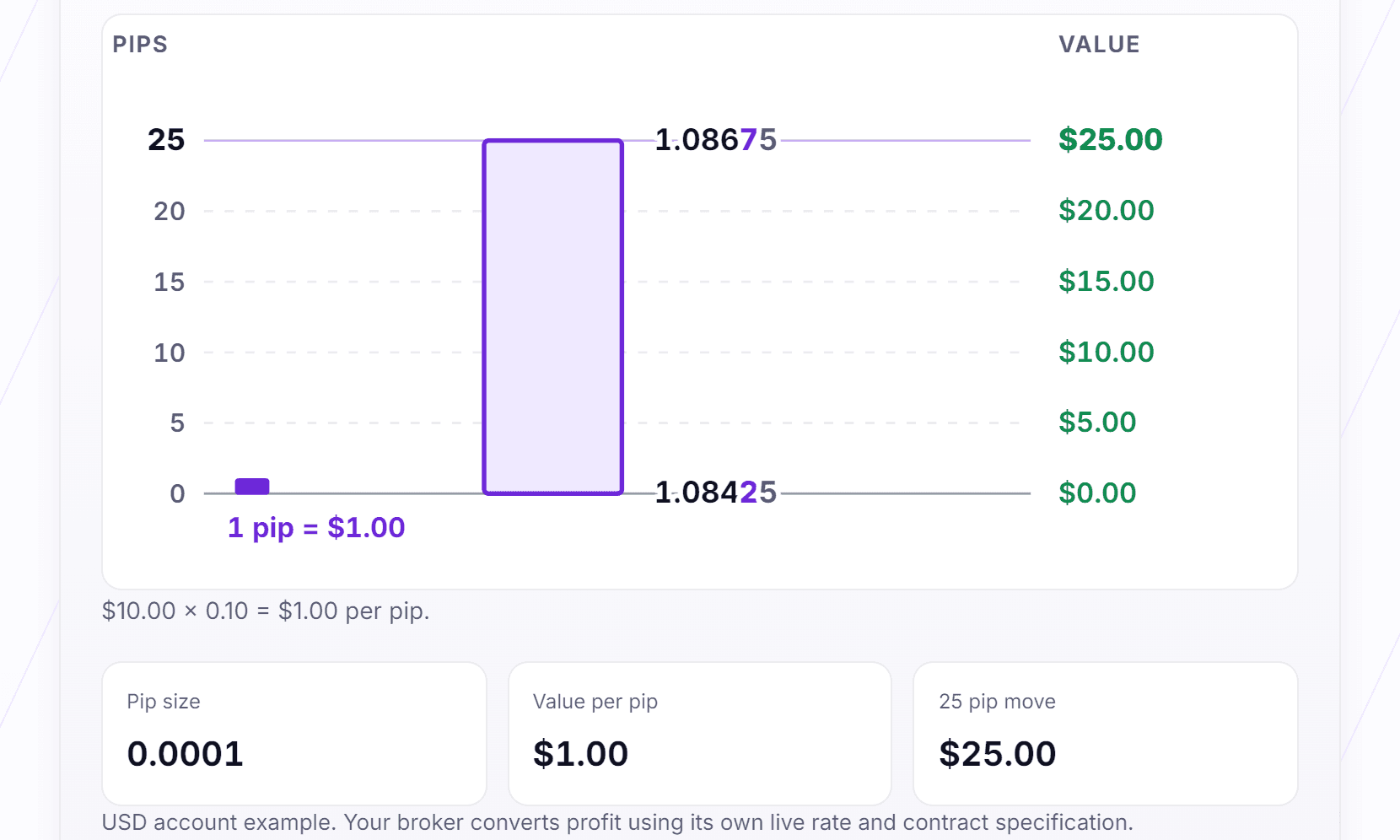
Choose EUR/USD, USD/JPY, or EUR/GBP, then change the price, lot size, or pip move. The tall bar is the move. The small bar beside it is one pip, drawn to the same scale.
Two scales run down the chart. Pips on the left, money on the right. Change the lot size and only the money column moves.
The tool assumes a 100,000-unit contract and a USD account. Choose EUR/GBP and a second price field appears, because a pair with no USD leg needs an outside rate. Three cases, not every pair.
Sample quote
EUR/USD 1.084252 is the pip5 is the pipette, one tenth of a pip
$10.00 × 0.10 = $1.00 per pip.
USD account example. Your broker converts profit using its own live rate and contract specification.
Start with the value in the pair's quote currency.
For EUR/USD, the calculation is short because the quote currency is already USD:
0.0001 × 100,000 × 0.10 = $1.00 per pip
USD/JPY needs a conversion. One pip on one lot is 0.01 × 100,000 = ¥1,000. At USD/JPY 150.00, that is about $6.67 per pip. At 0.10 lots, it is about $0.67.
Cross pairs need one more number. One pip on one lot of EUR/GBP is £10. Neither side of the pair is USD, so the conversion runs through GBP/USD. At 1.2700, £10 is $12.70. Choose EUR/GBP in the tool above and that rate gets its own field, because the pair's own price cannot supply it.
Your platform runs this conversion for you, at whatever the rate is when the trade closes. The dollar value of a EUR/GBP pip therefore drifts while the position is open. Treat the tool above as a worked example, then check the live value in your own platform before you size a trade.
A 20 pip stop on 0.10 lots of EUR/USD risks about $20 before trading costs. The same stop on 1.00 lot risks about $200.
The spread, commission, and slippage all add to the final loss. Set the stop from the trade idea first. Then choose a lot size that keeps the money at risk within your limit.
Open your platform's Specification window for the symbol and compare its live tick value against your planned stop before you risk money on the trade.
MetaTrader's symbol fields show the point, contract size, tick size, and tick value that a broker supplies. Those values beat a rule of thumb when the symbol is unusual.
No. A pip on one standard lot of EUR/USD is $10 because USD is the quote currency. USD/JPY is about $6.67 per pip at 150.00. Other pairs also need a currency conversion.
Usually not. On a five-decimal forex quote, one point is one pipette. Ten points make one pip. Check the symbol specification instead of assuming.
No. Price movement stays the same. A larger lot only makes each pip worth more money.
No. Pips are a forex convention. Check the point, tick size, and contract specification for CFDs, metals, indices, and crypto.
Use your broker's symbol specification and the platform's live tick value. The calculator above teaches the math. The platform gives the number that applies to your account and symbol.
Trading EducationSlippage is the gap between the price you expect and the price your forex order fills at. It differs from spread and depends on available liquidity.
 Trading Education
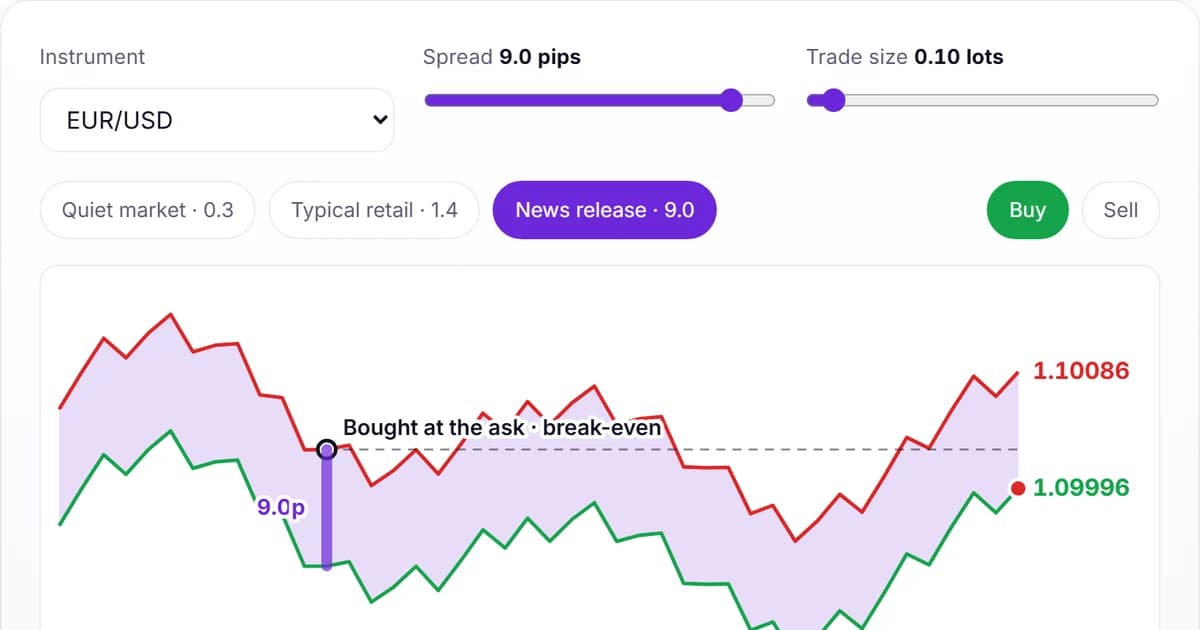
The spread in forex is the gap between the bid and the ask price. See what it costs, why it widens, and how to check it, on an interactive bid-ask chart.
 Trading Education
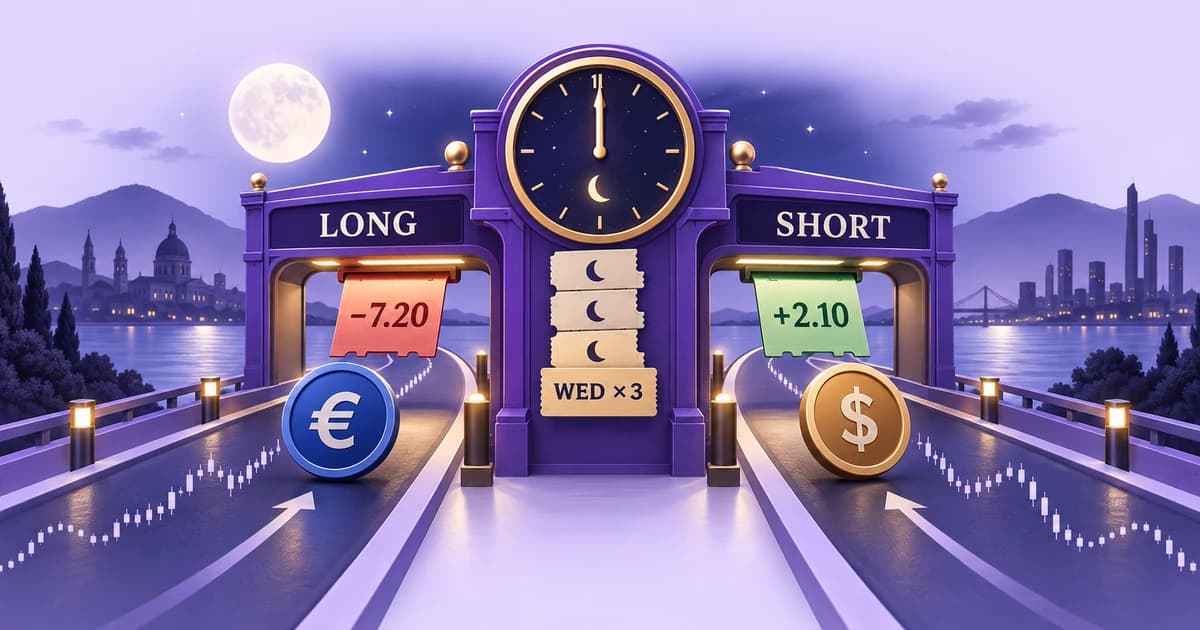
Forex swap is the overnight financing charge or credit on an open position. See why long and short differ, when triple swap lands, and try it yourself.