
 Trading Education
Forex Spread vs Commission Compared
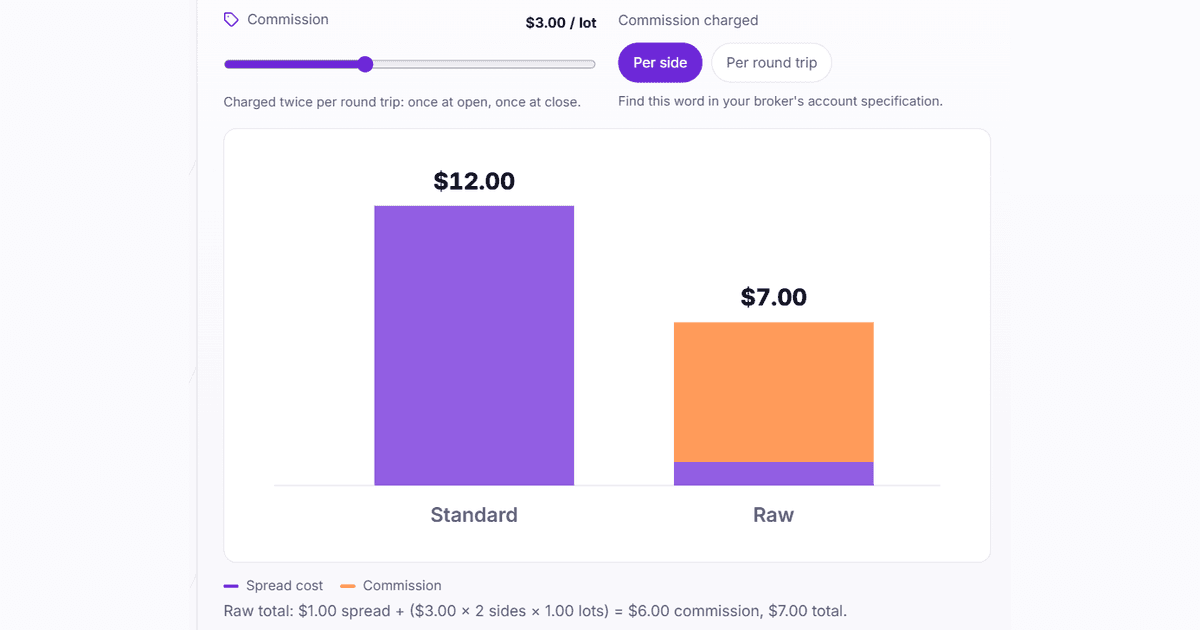
A raw-spread account looks cheaper until commission is added. Compare full trading cost by pair, lot size, and trade frequency.
Forex swap is the overnight financing charge or credit on an open position. See why long and short differ, when triple swap lands, and try it yourself.
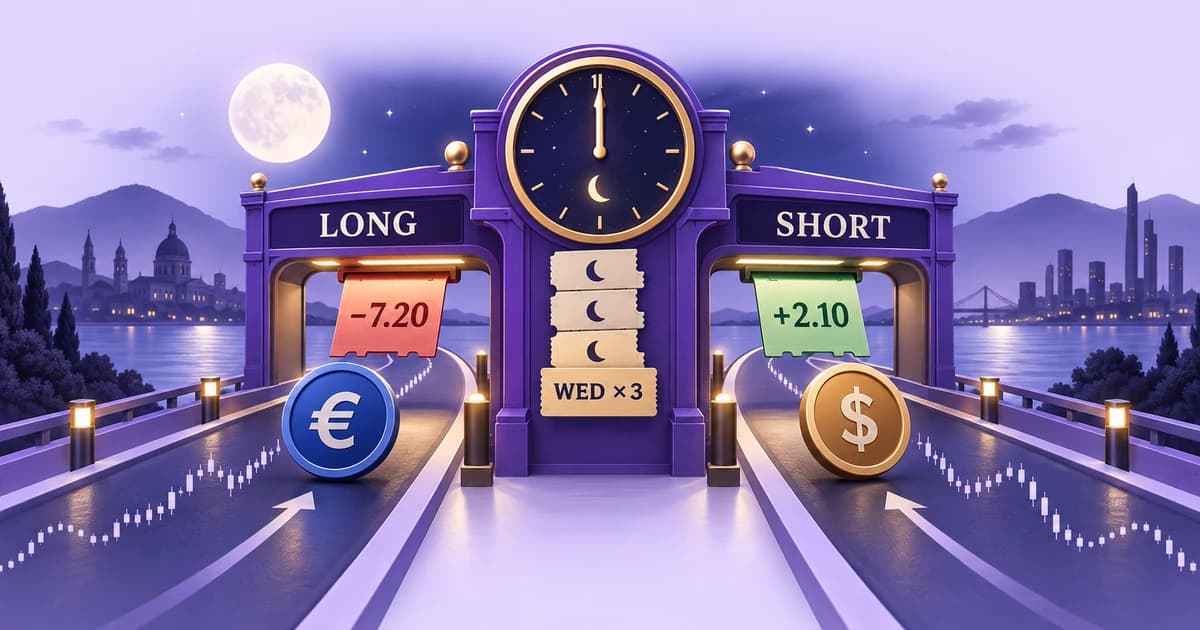
Swap in forex is what your broker charges you, or pays you, for keeping a position open past the end of the trading day. It has nothing to do with whether the trade is winning. It is rent on the money behind the position.
Traders meet it the same way every time. They hold a small winner for four days, close it, and most of the profit is missing. Price did exactly what they wanted. Four nights of swap took the rest.
Every number below is a worked example, not a quote. Brokers set swap per instrument, change it daily, and do not all use the same triple-charge weekday, so read your own broker's contract specification before you plan around any of this.
Contents
Every forex trade is two positions at once. Buy EUR/USD and you are holding euros and owing dollars. You earn interest on the currency you hold and you pay interest on the currency you owe.
The difference between those two rates is the swap. If the currency you hold pays more than the one you owe, the difference lands in your account as a credit. If it pays less, you are charged.
Then your broker takes a cut. That markup is why both sides of the same pair are often negative, and why one broker credits a position that another broker charges for.
Your broker applies the charge once per rollover. Not hourly, and not per calendar day. Everything else in this article follows from that one fact.
Set an instrument, pick a direction, and drag the sliders. Each bar is one night you held the position. Bars above the line are credits, bars below are charges.
One rolloverWednesday night, three rolloversClosed, no rollover
Swap rates change daily and every broker sets its own per instrument. Put your broker's long and short numbers in the two rate fields to price your own position.
Do three things before you read on.
Flip Direction from Long to Short and leave everything else alone. On most instruments the total changes size as well as sign, because the broker applies its markup to both sides.
Set Hold from to Monday and Nights held to 7. You held for a week and paid on four nights. One of those counts triple, and three cost nothing at all.
Then type your own broker's two rates into the rate fields. The presets are illustrative. Your account is the only source that counts.
In theory, the swap you pay to hold a pair long is the swap you receive to hold it short. In practice it never is.
The broker quotes two separate numbers, swap long and swap short, and keeps a spread between them exactly as it does on price. On a pair with a small interest differential, that markup is often larger than the differential itself, which is how both directions end up negative.
So a symbol that charges you to be long and also charges you to be short is the normal shape of a retail swap table, not a fault in your platform. Check both numbers before you assume a short is being paid to wait.
Rollover happens at one instant per day, usually 00:00 on your broker's server clock, which for most brokers is 17:00 in New York. Hold a position across that instant and you pay a full night. Hold it for eleven hours that do not cross it and you pay nothing.
That is the whole rule, and it cuts both ways. A day trader who flattens before the server day ends never sees a swap line. A trader who opens five minutes before rollover and closes ten minutes after pays a full night for fifteen minutes of exposure.
If you are unsure where your broker's day ends, put the server clock on the chart and watch the spread in Market Watch. Liquidity thins out at rollover and spreads on most pairs widen for a few minutes around it, which is a bad moment to open anything.
Spot forex settles two business days after the trade date. When Wednesday night's rollover pushes the value date forward, it lands on Monday rather than Saturday, so three days of interest fall due at once. That is why most brokers charge triple swap on Wednesday and nothing on Friday, Saturday or Sunday nights. The weekend has already been paid for.
The trap is assuming this is a market-wide rule. It is not. Metals, indices and cash CFDs settle on other cycles and carry their triple charge on another weekday, some brokers shift theirs to Friday across the board, and crypto CFDs often charge every night of the week.
Two minutes in the contract specification settles it for your account. Guessing costs more than that.
MetaTrader shows the calculation mode next to the two rates, and the mode changes what the numbers mean.
| Mode | What the number means | Nightly amount |
|---|---|---|
| Points | Swap quoted in price points | Points × point value per lot × lots |
| Money | Swap quoted in a currency, per lot | Amount × lots |
| Percent (annual) | Annual interest rate on the position value | Position value × rate ÷ 360 or 365 |
Points mode is the most common on forex symbols. As an illustration, a swap long of -7.2 points on EUR/USD at a point value of $1 per lot costs $7.20 a night on one standard lot, $0.72 on 0.10 lots, and triple that on the triple-charge night. Position size is the only thing that scales it.
Percent mode catches people out, because the charge tracks the value of the position instead of a fixed figure per lot. One lot of gold is 100 ounces, so a 3 percent annual rate costs $20 a night at 2,400 an ounce and cost $15 at 1,800.
They arrive on the same statement and they behave nothing alike.
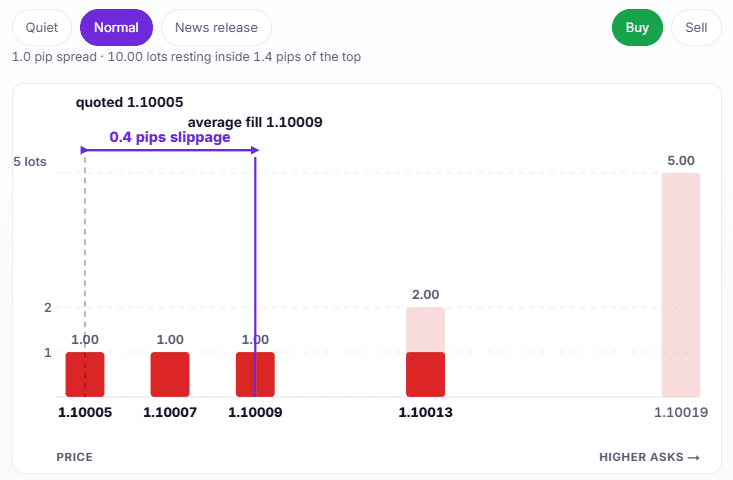
The spread is the gap between bid and ask. You pay it once, when the position opens, however long you hold. Commission is a per-lot charge on raw-spread accounts, usually per side, and comparing the two pricing models only works on the total. Slippage is the difference between the price you expected and the fill you got, and it happens at the moment of execution.
Swap is the only one of the four that depends on time. You pay the other three per trade. You pay swap per rollover, so a strategy that holds positions meets a cost that a strategy closing every day never sees.
It is also the cost most often missing from a backtest. The tester can apply swap, but it uses today's rate for the whole history, so a two-year carry test is an approximation.
Run one calculation before any multi-day entry. Nightly swap, times the nights you expect to hold, against the profit you are aiming for.
For a scalper the answer is zero and the question is not worth asking. For a swing trader holding three to ten days on 0.50 lots, a negative swap of a few dollars a night against a sixty pip target takes five to fifteen percent of the result.
Hold for months and swap stops being a cost and becomes the strategy. A position that pays you to wait can carry a trade through a drawdown that would otherwise close it. A position that charges you to wait sets a deadline the chart knows nothing about, and if your higher timeframe thesis needs six weeks to play out, the financing belongs in the plan from the start.
My rule is blunt. If swap takes more than ten percent of the target, it is a parameter of the strategy and it goes in the written plan. Below that, note it and move on. Either way, if your positions sit open overnight, Equity Tracker MT5 reports the equity change that lands at rollover instead of leaving you to find it the next morning.
Right-click a symbol in Market Watch and choose Specification. Scroll to the swap block. You want four fields: Swap long, Swap short, Swap type, and the three-day swap weekday.
Those four values are everything the arithmetic needs. Copy them into the simulator above and the illustration becomes your account.
To see what you have already paid, open the Toolbox, go to History, and add the Swap column if it is hidden. Each closed position shows its accumulated swap separately from profit, so you can read what a holding period cost instead of estimating it. The Trade tab shows the running total on positions that are still open.
Check the rates again when a central bank moves. Brokers rewrite swap tables without telling anyone, and a carry that was positive last quarter can be negative this one.
It is interest. You hold one currency and owe another, so you earn one interest rate and pay the other. Your broker credits or charges the difference, minus its markup, once a day while the position stays open.
Swap has nothing to do with profit and loss. Brokers charge it on every position open at rollover, winning or losing, and it appears as its own line rather than inside the trade result.
Close positions before your broker's rollover time, usually 00:00 server time. Intraday trading avoids swap. Holding overnight does not, and no order type changes that.
Spot forex settles two business days forward, so Wednesday's rollover carries the value date over the weekend and three days of interest fall due at once. Most brokers do this on Wednesday for forex, but the weekday differs by instrument and by broker, so confirm it in the contract specification.
Yes. If the currency you are long pays a higher interest rate than the one you are short, and the differential survives the broker's markup, you receive a credit each night. Read both the swap long and the swap short field, because a credit in one direction does not imply a charge of the same size in the other.
They remove the interest charge, which matters if your reason for avoiding it is religious rather than financial. Brokers usually recover the cost another way, through a wider spread, an administration fee after a number of days, or a shorter symbol list. Read the terms rather than the label.
Yes, and often on a different basis. Many of these symbols use percent mode, so the charge scales with the value of the position, and some crypto CFDs apply financing every night of the week.
Rates live in the symbol specification, under Swap long and Swap short. Charges already applied show in the Toolbox, in the Swap column of the History tab for closed positions and the Trade tab for open ones.
Trading EducationA raw-spread account looks cheaper until commission is added. Compare full trading cost by pair, lot size, and trade frequency.
 Trading Education
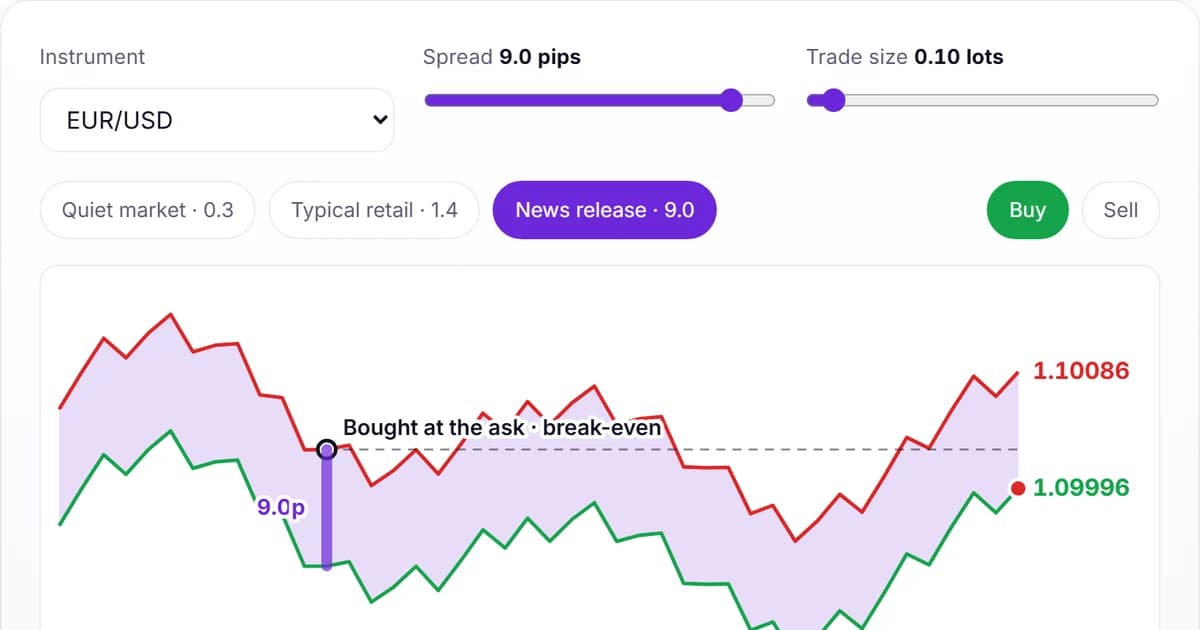
The spread in forex is the gap between the bid and the ask price. See what it costs, why it widens, and how to check it, on an interactive bid-ask chart.
 Trading Education
Slippage is the gap between the price you expect and the price your forex order fills at. It differs from spread and depends on available liquidity.