
 Trading Education
Forex Spread vs Commission Compared
A raw-spread account looks cheaper until commission is added. Compare full trading cost by pair, lot size, and trade frequency.
The spread in forex is the gap between the bid and the ask price. See what it costs, why it widens, and how to check it, on an interactive bid-ask chart.
The spread in forex is the difference between the bid price, at which you can sell a currency pair, and the ask price, at which you can buy it. It is quoted in pips, it is how most brokers charge for a trade, and you pay it the moment a position opens.
That last part is what surprises people. You buy EUR/USD, price has not moved a single tick, and the position already shows a small loss. Nothing broke. You just met the spread.
About the author: Carlos Oliveira — I build trading tools for MetaTrader and run ForexTradingTools.eu. The pip and dollar figures below are worked examples, and the pip ranges in the typical-spreads table are broker rate cards during active hours, not a live feed, so check your own broker's Market Watch for the number that actually applies to your account.
Contents
Look at a EUR/USD quote in MetaTrader 5 and you will see something like 1.09995 / 1.10005. The first number is the bid, the second is the ask.
The bid is the price at which you can sell. The ask is the price at which you can buy. You always buy at the higher one and sell at the lower one, which means the market has to move in your favour before a trade turns positive.
The distance between bid and ask is the spread. In the example above it is 0.00010, or 1.0 pip on a five-decimal EUR/USD quote.
A pip is the standard unit of movement for a currency pair. For most pairs it is the fourth decimal place (0.0001). For pairs quoted against the Japanese yen it is the second decimal (0.01). Brokers quote one extra digit beyond the pip, called a point or pipette, which is why a spread of 1 pip shows as 10 points on some platforms.
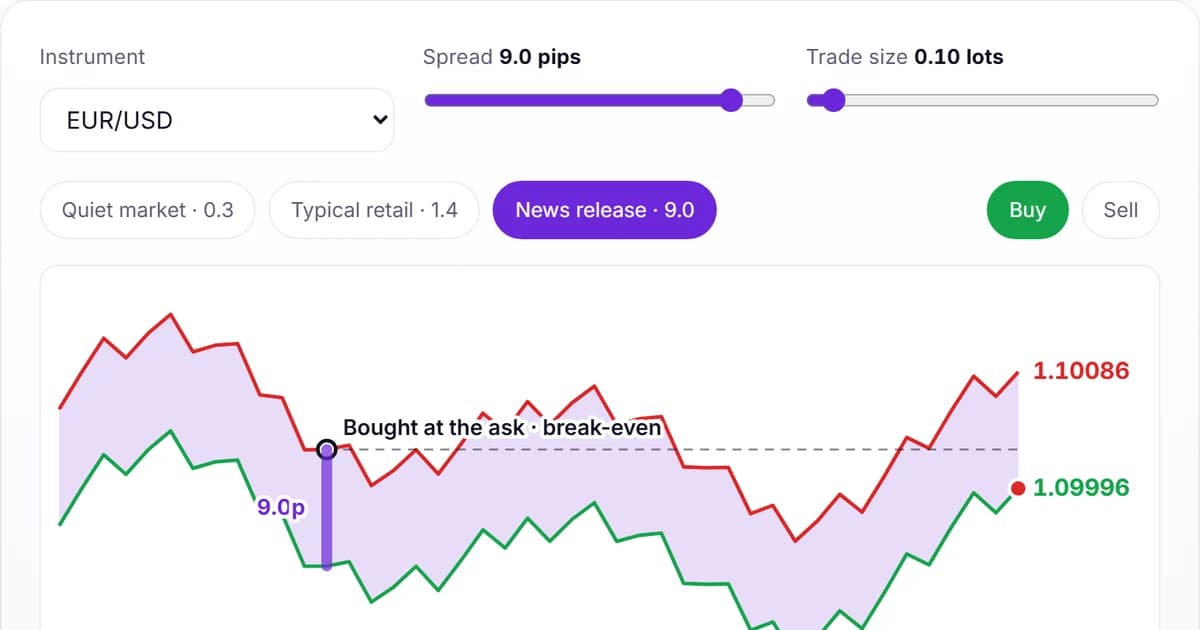
The chart below plots the same price twice. The red line is the ask, the green line is the bid, and the shaded ribbon between them is the spread. Drag the spread slider and watch the ribbon breathe.
The market moved the same distance whichever spread you pick. Widen the gap and the trade opens further underwater, so more of that move is spent getting back to where you started.
The dot on the left is where a trade was opened, and the dashed line running from it is the break-even level. For a buy you enter on the red line and exit on the green one, so the green line has to climb all the way back to the dashed level before the position is even. Switch to Sell and the roles swap.
Drag the spread from 0.3 pips to 9 and leave everything else alone. The price wiggle never changes, only the ribbon. Those two numbers are a quiet London afternoon and the ten seconds around a rate decision, and in the second one the trade falls further behind without the market doing anything at all.
Trade size works the other way round: ten times the lots, ten times the cost, same market. USD/JPY is worth a look too. The pip there is a hundred times bigger in nominal terms (0.01 instead of 0.0001) and worth about two thirds as much in dollars, because the pair trades near 150 instead of near 1.10.
The formula behind the four boxes under the chart is short enough to do in your head.
Spread cost = spread in pips × pip value per lot × lots traded.
One standard lot is 100,000 units of the base currency, so on a USD-quoted pair one pip is worth $10 per lot. A 1.4 pip spread on 0.10 lots therefore costs 1.4 × $10 × 0.10, which is $1.40. The same spread on 1.00 lots costs $14.00, because the spread scales with position size and nothing else.
For a pair quoted in Japanese yen the pip is 0.01, so a pip on one lot is worth ¥1,000, which you convert at the current rate. At 150.00 that is about $6.67 per pip per lot, and the simulator does the conversion for you when you switch to USD/JPY.
The break-even distance is always exactly the spread, measured in pips. A 1.4 pip spread means price must travel 1.4 pips your way before you are level. Open a trade and the platform immediately values it at the opposite side of the quote, which is why a brand new position shows a small loss. That is normal, and it is not a sign that your broker cheated you.
Open profit or loss reads the trade at the current bid or ask. The small line underneath shows the same number after the spread has been taken out of the move, so on a 6 pip advance with a 1.4 pip spread you keep 4.6.
Twenty trades at $1.40 comes to $28. That is where a cost which looked trivial on one trade turns into a real drag, and a strategy averaging $2 of profit per trade has just handed most of its edge back to the broker.
Spreads are set by supply and demand for the currency itself, filtered through your broker.
Liquidity does most of the work. EUR/USD is the most traded pair in the world and usually shows the tightest spread on the platform, while an exotic such as USD/TRY sits twenty times wider all day long because far fewer people want to trade it.
Then there is the clock. London and New York overlap for a few hours each afternoon in Europe, and the majors are at their tightest inside that window. Trade the same pair late in the New York session, or during the Asian session, and it can cost several times more.
News is the violent one. In the seconds around a central bank decision or a payrolls release, market makers pull their quotes and spreads jump from under a pip to ten or more. A stop loss sitting inside that range gets triggered by the spread alone while the mid price never reaches it, which is why a tight stop held through a scheduled release is a bad bet. Check the calendar first, or keep a news panel on the chart so the release never arrives as a surprise. Sunday's opening quotes behave the same way, wide until liquidity comes back.
Advertised spreads vary by broker and account type, so treat these as the range a retail trader should expect during the London and New York hours, not a quote. Outside those hours, assume the wider end.
| Pair | Raw account (plus commission) | Standard account | Cost per 0.10 lots, standard |
|---|---|---|---|
| EUR/USD | 0.0 to 0.3 pips | 0.8 to 1.6 pips | $0.80 to $1.60 |
| GBP/USD | 0.1 to 0.5 pips | 1.2 to 2.2 pips | $1.20 to $2.20 |
| USD/JPY | 0.1 to 0.4 pips | 1.0 to 1.8 pips | $0.67 to $1.20 |
| AUD/USD | 0.1 to 0.5 pips | 1.2 to 2.0 pips | $1.20 to $2.00 |
| EUR/GBP | 0.2 to 0.7 pips | 1.5 to 2.5 pips | $1.90 to $3.20 |
| USD/TRY (exotic) | 15 to 40 pips | 30 to 80 pips | ≈$0.75 to $2.00 |
| XAU/USD (gold) | 10 to 20 cents | 25 to 50 cents | $2.50 to $5.00 |
Read the exotic row twice, because it shows why pips alone never answer the question. A 30 pip spread on USD/TRY sounds catastrophic next to 1.2 pips on EUR/USD, but the lira trades above 40 to the dollar, so each pip is worth about 25 cents per lot instead of $10. The cost lands closer to a EUR/USD trade than the pip count suggests. Always convert to money before you judge a spread.
Brokers advertise two models, and neither of them is free.
A variable (or floating) spread moves with the market. It is usually cheaper than the fixed alternative, sometimes dramatically so, and it widens exactly when you least want it to. Almost every ECN and raw-spread account works this way, with a separate commission on top.
A fixed spread holds the advertised number in normal conditions, so you pay more on average in exchange for knowing the cost in advance. Those accounts still widen or requote during major news, whatever the marketing says.
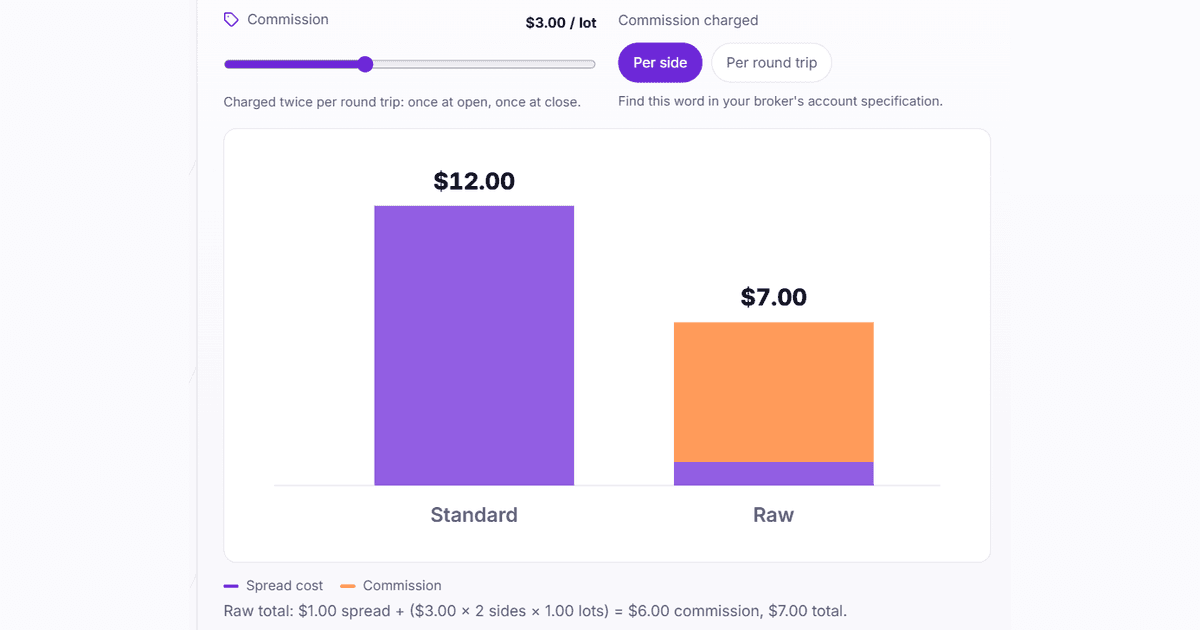
Commission is the part the comparison tables leave out. Raw-spread accounts quote a headline spread near zero and charge around $3.50 per lot per side, so your real cost is spread plus commission. Compare on that total.
Spread is not the only cost of holding a position, but you pay it on every single trade, however long you hold.
For a swing trader holding several days, one pip against a 60 pip target is noise, under two percent of the trade. For a scalper taking 5 pip targets, that same pip is twenty percent of the target and it gets paid on every entry, so the strategy needs a far higher hit rate than it looks like it needs on paper.
It is also why a strategy can look profitable in a backtest that assumed a fixed 1 pip spread and lose money live, where the same trades paid 2 pips at the wrong hour. This is why the same setup can be profitable on the H4 chart and a slow bleed on the M1 chart. Nothing about the pattern changed. The cost per trade stayed the same while the profit per trade shrank. If you are working on a short-term system, run the numbers on scalping costs before you commit to it.
Spread also interacts with your stop placement. Buy orders are closed at the bid, so a long stop loss triggers when the bid touches it, and the ask you entered on was higher. Leave a small buffer beyond the level you actually care about, sized to the typical spread on that pair, not to a round number. The same logic applies when you size the position itself.
In MetaTrader 5, right-click the Market Watch window and tick Spread. A column appears showing the live spread in points for every symbol you follow. Watch it for a few minutes at the hour you normally trade, not once at midday, because the number you see at 15:00 in London says nothing about the one at 03:00.
The ask line is switched off by default. Turn it on under Chart Properties so both quotes are visible, and on a wide-spread pair the gap between the candles and that line is a surprise the first time.
Then compare what you see against what counts as normal for that symbol. Much wider usually means thin liquidity or an event about to land, and both are reasons to wait.
If you want the session boundaries on the chart itself, so you know at a glance whether you are inside the tight London/New York overlap or the wider hours either side of it, ChartDeck PRO draws them for you alongside the other tools it runs.
Because you bought at the ask and the platform values the position at the bid. The difference is the spread. Price has to move by that amount before the position reads zero.
No. Accounts that advertise spreads from 0.0 pips charge a commission per lot instead. Add the commission to the spread to compare like with like.
You pay it once per round trip. The cost appears the moment you open, because the position is immediately marked at the opposite side of the quote, and it does not get charged again when you close.
As a rough benchmark today, under 1.5 pips on a standard account during the London and New York sessions is competitive, and 0.0 to 0.3 pips plus commission is competitive on a raw account. Anything consistently above 2 pips in active hours is expensive for that pair. Treat these as a starting point, not a promise: they move with broker, liquidity, and market conditions, so confirm the live number on your own account before you judge it.
Yes. For a long position, the stop and target are evaluated against the bid. For a short position, they are evaluated against the ask. A stop that sits within spread distance of the current price can be hit by a spread widening on its own.
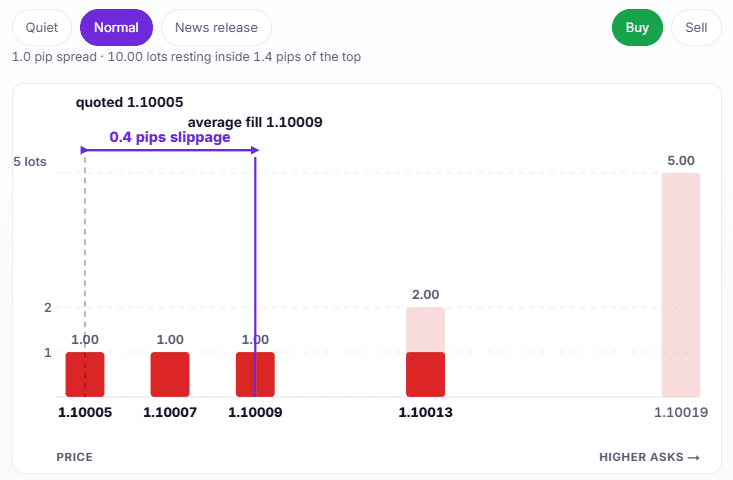
The spread is the gap between bid and ask that exists before you click. Slippage is the difference between the price you expected and the price you actually got, usually because the market moved between your click and the fill. You can see the spread in advance. Slippage you only see afterwards.
Less than for scalpers, but it never reaches zero. A position held for weeks pays the spread once, against a target measured in hundreds of pips, so it rounds to nothing. Swap (the overnight financing charge) becomes the cost that matters instead.
Yes, and the gap between brokers on the same pair at the same moment can be significant. It is one of the few costs you can reduce without changing anything about how you trade.
Trading EducationA raw-spread account looks cheaper until commission is added. Compare full trading cost by pair, lot size, and trade frequency.
 Trading Education
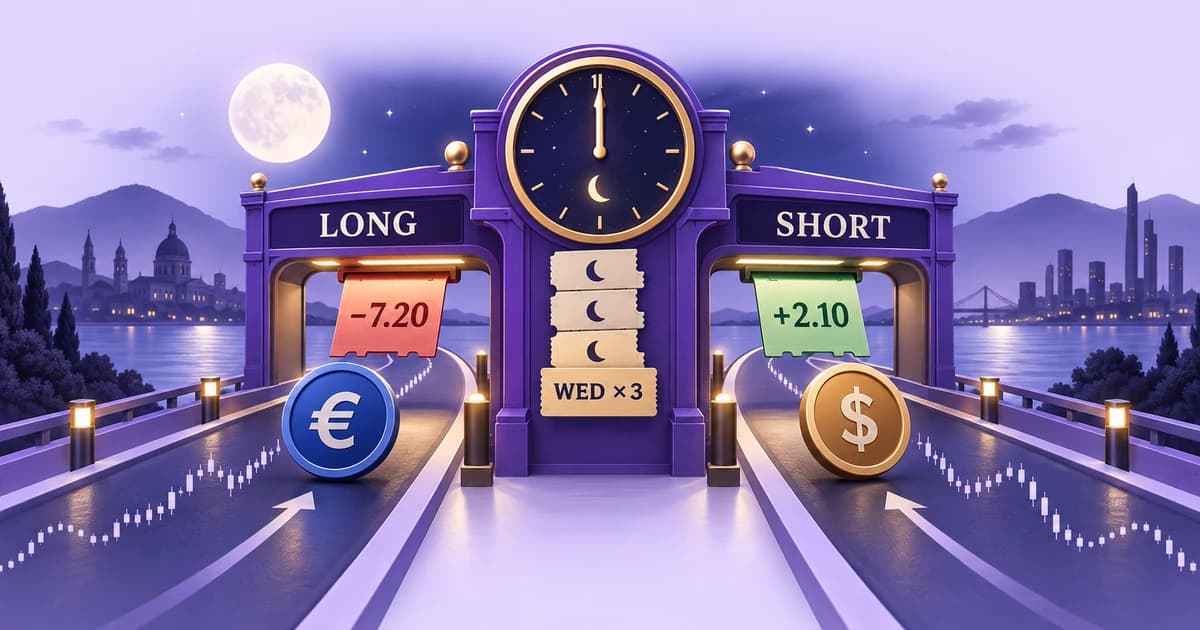
Forex swap is the overnight financing charge or credit on an open position. See why long and short differ, when triple swap lands, and try it yourself.
 Trading Education
Slippage is the gap between the price you expect and the price your forex order fills at. It differs from spread and depends on available liquidity.