
 Trading Education
What Is the Spread in Forex?
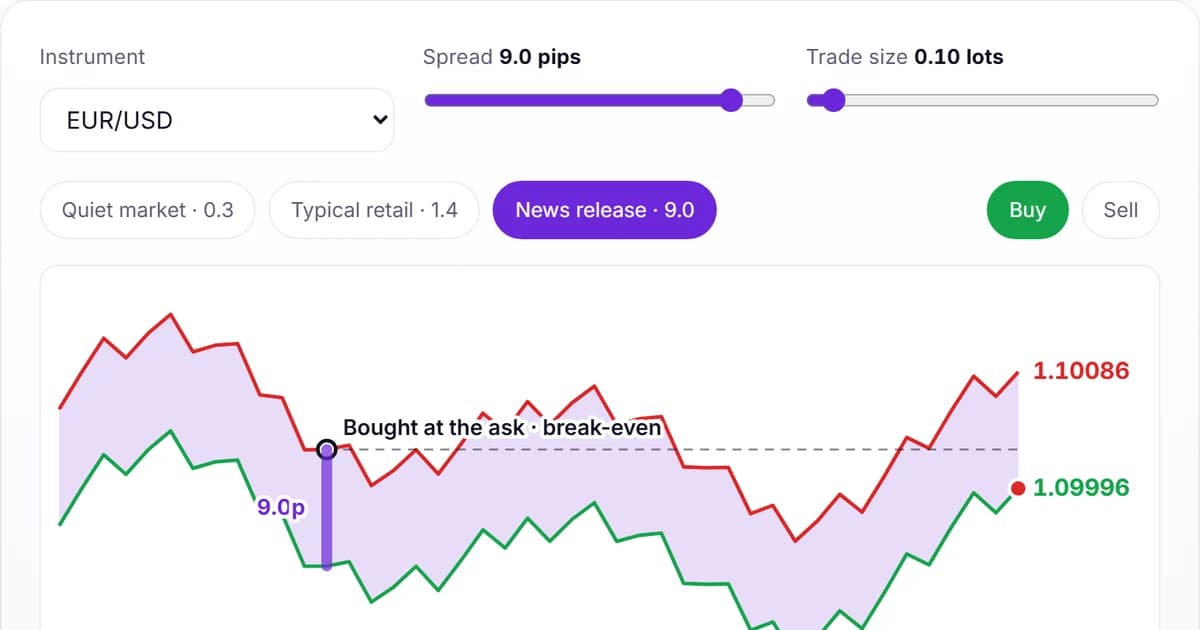
The spread in forex is the gap between the bid and the ask price. See what it costs, why it widens, and how to check it, on an interactive bid-ask chart.
A raw-spread account looks cheaper until commission is added. Compare full trading cost by pair, lot size, and trade frequency.
A raw-spread account advertises a spread near zero. A standard account advertises "no commission." Read only the headline number and the raw account always looks cheaper. Add up what you actually pay on one trade and the answer depends on your pair, your lot size, and how often you trade, not on which number the broker put in bold.
About the author. Carlos Oliveira, I build trading tools for MetaTrader and run ForexTradingTools.eu. The figures below are worked examples with round numbers, not quotes from any specific broker. Check your own broker's account specification before you compare.
Contents
Every broker prices a trade the same way underneath. You pay the bid-ask spread, and on some accounts a separate commission on top of it. The two pricing models just split that cost differently.
A standard account folds everything into the spread. A raw-spread (often called ECN or raw) account quotes a much thinner spread and charges the rest as a fixed commission per lot. Neither model is a discount. One bills you a wider gap between bid and ask; the other bills you a line item on your statement. The only number that tells you which is cheaper is the total.
On a standard account, the broker's fee is already built into the spread you see quoted. There is no separate line item and nothing extra to calculate.
Standard-account spreads vary by broker, instrument, and session, so take the figure from your broker's own quote. As a worked example, assume a 1.2 pip EUR/USD spread. Using pip value for EUR/USD, one lot moves $10 per pip, so the spread costs:
1.2 pips × $10 per pip × 1.00 lot = $12.00
That $12.00 is the entire cost of the trade. It is not a fee charged at the open: the platform marks a new position at the opposite side of the quote, so the trade starts $12.00 down, and that gap is realised through the price you exit at.
A raw-spread account passes a much thinner spread through (assume 0.1 pips on EUR/USD for this example; your broker's live quote is what counts) and adds a fixed commission per lot to cover what the standard account's wider spread would otherwise pay for.
A common commission structure is $3.50 per lot per side, charged once on open and again on close. On the same EUR/USD trade, at a 0.1 pip spread and 1.00 lot:
Spread: 0.1 pips × $10 per pip × 1.00 lot = $1.00
Commission: $3.50 × 2 sides × 1.00 lot = $7.00
Total: $8.00
The spread portion barely registers. The commission is where most of the raw account's real cost lives, and it does not move with the market the way a spread does.
Put the two totals side by side on the identical trade, EUR/USD, 1.00 lot, one round trip:
| Account type | Spread cost | Commission | Total cost |
|---|---|---|---|
| Standard | $12.00 (1.2 pips) | $0.00 | $12.00 |
| Raw | $1.00 (0.1 pips) | $7.00 ($3.50 × 2 sides) | $8.00 |
On these example numbers the raw account is $4.00 cheaper. Recompute it on your own broker's actual spread and commission before you trust that gap. Both sides of the table move.
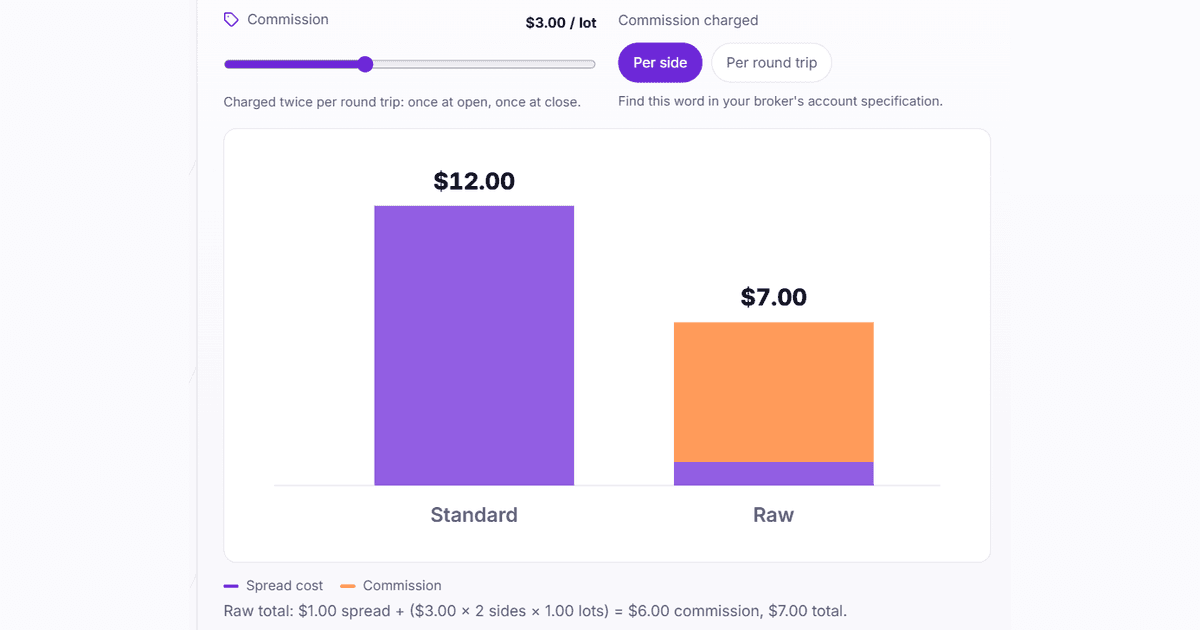
The chart below builds the same ledger live: each bar is one round trip, and the raw bar stacks a thin spread underneath its commission so you can see how much of the raw total is commission.
One round trip, right now
1.00 lot of EUR/USD moves $10.00 per pip. Standard pays for the trade in spread alone. Raw splits it between a thinner spread and a commission.
Raw total: $1.00 spread + ($3.50 × 2 sides × 1.00 lots) = $7.00 commission, $8.00 total.
Example numbers on a USD account. Recompute with your own broker's spread and commission before you trust the result.
Brokers quote commission two different ways, and mixing them up is the easiest way to misjudge an account.
Per side means the commission is charged once on opening and again on closing: a $3.50 per lot per side commission costs $7.00 per round trip on 1.00 lot. Per round trip means the quoted number already covers both legs, so $7.00 per lot round trip also costs $7.00. A broker who just says "$3.50 commission" leaves you to guess which one. Guess wrong and the real cost comes out double.
Find the word "side" or "round trip" (sometimes "round turn") in the account specification before you compare. If it is not stated, ask your broker — NFA Compliance Rule 2-36 requires US forex dealers to disclose commission and mark-up on a per-trade basis, so the answer must be on record somewhere. The two readings differ by exactly a factor of two.
The comparison above assumed a 1.2 pip standard spread. That number is not fixed, and the gap between accounts shrinks as it moves.
With the same raw pricing (0.1 pips plus $7.00 commission on 1.00 lot, an $8.00 raw total), the standard account only needs to widen or narrow to change who wins:
The commission does not move with the market. That is the real edge of a raw account. It does not spike when liquidity dries up, the way a standard spread does, and it will not always be the cheaper total either.
Spread and commission are round-trip costs, charged once whether you hold a position for ten seconds or ten days. Holding time does not change the $4.00 gap in the example above.
What changes with holding time is swap, the overnight financing charge you pay for every night a position stays open. Ten nights held means ten nights of swap, on either account type, on top of the spread-and-commission total fixed the moment the trade opened. Spread and commission scale with how often you trade. Swap scales with how long you hold.
That split is why account choice matters most to trade frequency, not holding time. A scalper opening and closing 20 times a day multiplies the $4.00 gap by 20, an $80 daily difference between account types. A swing trader placing two trades a month multiplies it by two, an amount swap and the trade's own profit target dominate long before the account type does.
Your broker's account specification page states the answer directly: it names the commission unit and billing basis, and your platform's live Market Watch shows the spread that formula actually runs on.
There is no account type that wins every comparison. Run your own pair, lot size, and trade frequency through both formulas, and let the total decide, not the label on the account.
That one word changes the total by a factor of two: a $3.50 per-side commission is $7.00 per round trip on one lot, but a $3.50 per-round-trip commission stays at $3.50. Read the account specification for the exact wording, or ask your broker if it is not stated.
Not the advertised minimum during the tightest hour of the week. Watch the live spread on your own platform's Market Watch during your normal trading session, since that is the number your formula actually runs on.
Most brokers charge commission per lot, so it scales with trade size the same way spread cost does. Confirm this on your own account specification rather than assuming it.
Frequency decides which account type wins: a scalper running fifty round trips a week multiplies a small per-trade gap into a large one, while a swing trader placing one trade barely feels it.
Trading EducationThe spread in forex is the gap between the bid and the ask price. See what it costs, why it widens, and how to check it, on an interactive bid-ask chart.
 Trading Education
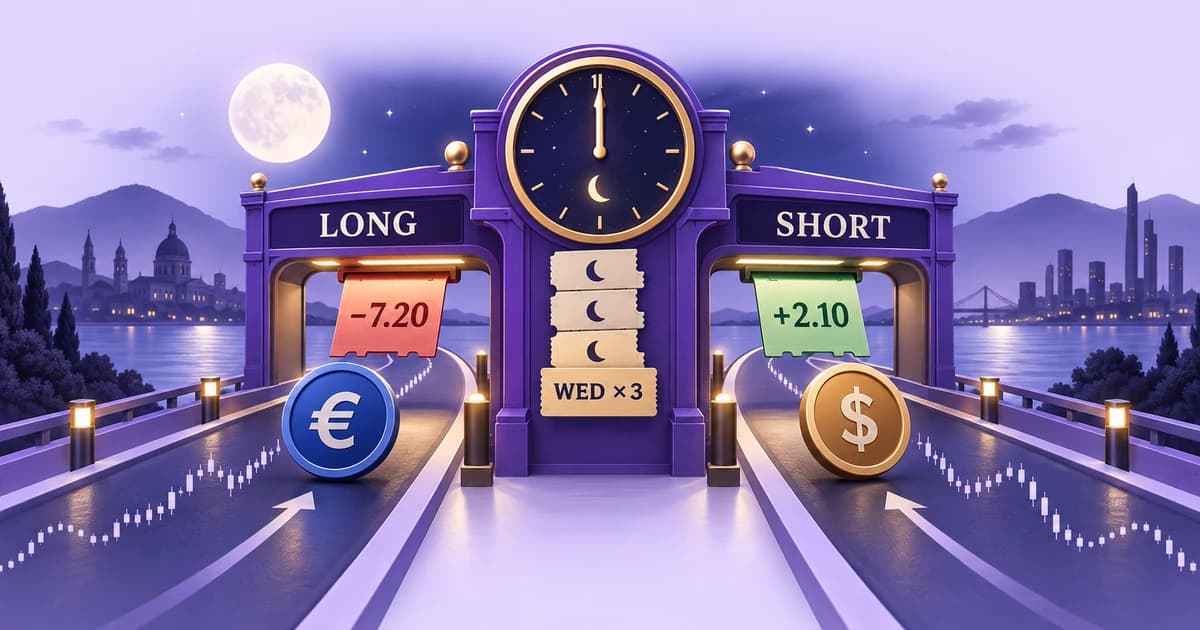
Forex swap is the overnight financing charge or credit on an open position. See why long and short differ, when triple swap lands, and try it yourself.
 Trading Education
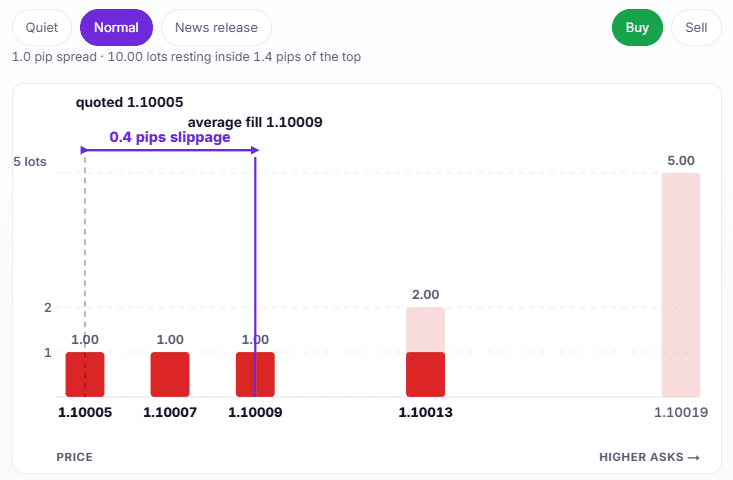
Slippage is the gap between the price you expect and the price your forex order fills at. It differs from spread and depends on available liquidity.